
Last updated September 20, 2026
Free on-site gate assessment - hinges, posts, and your LiftMaster or Nice gate operator checked before anything is quoted
The assessment is free and the quote is the invoice.
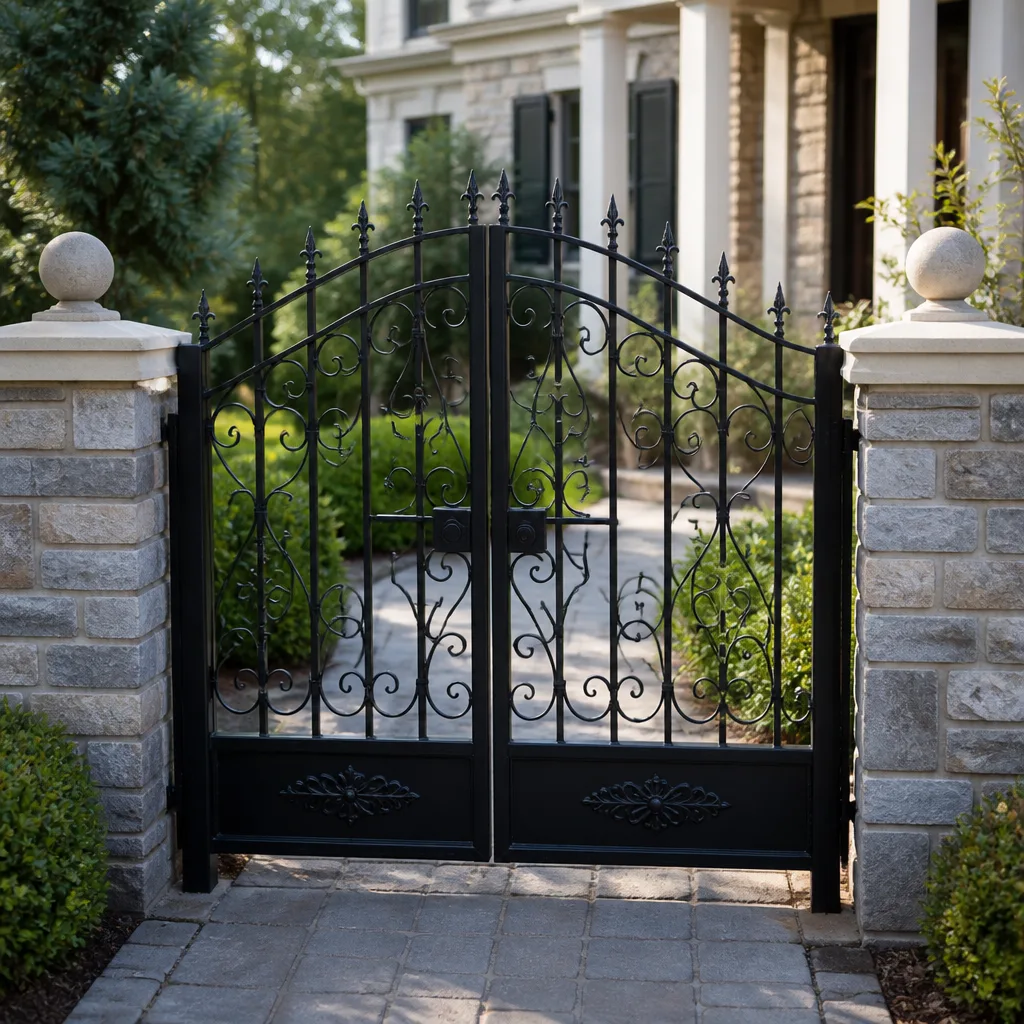
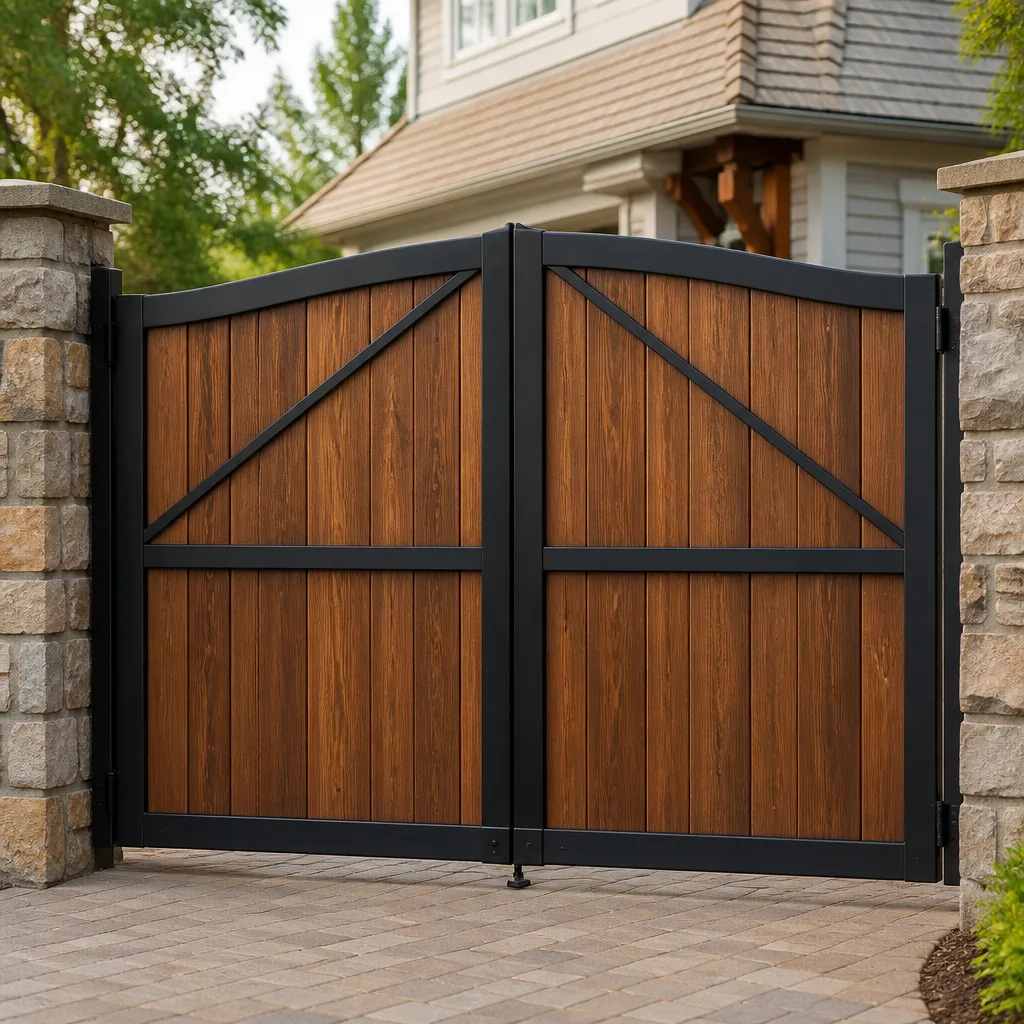
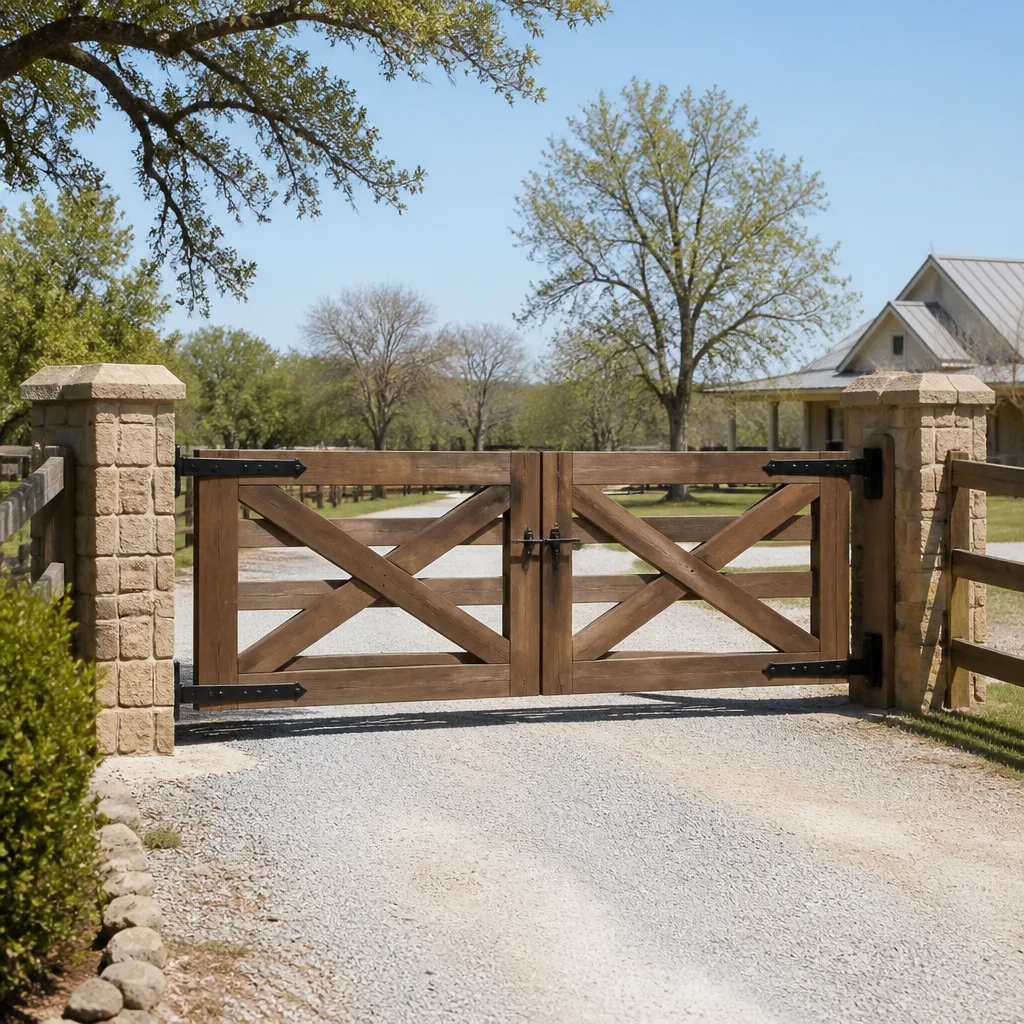
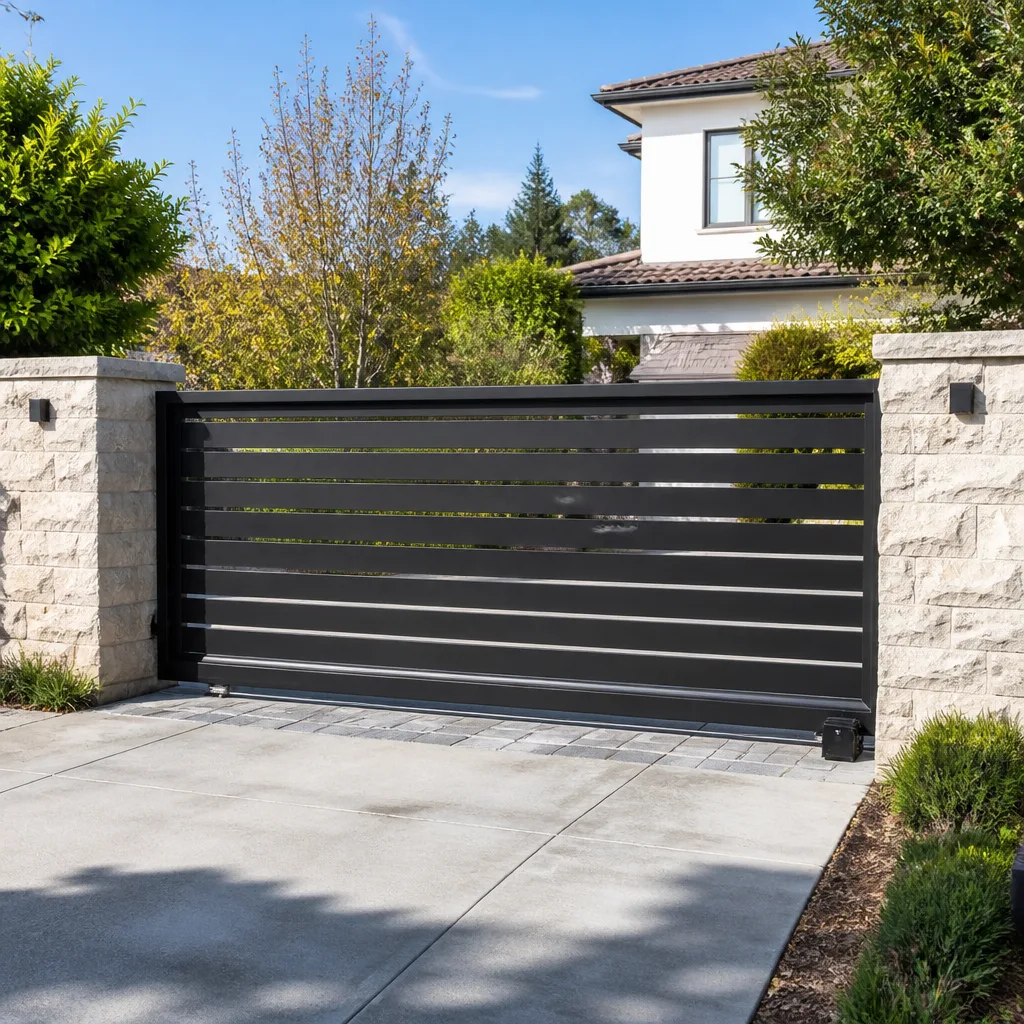
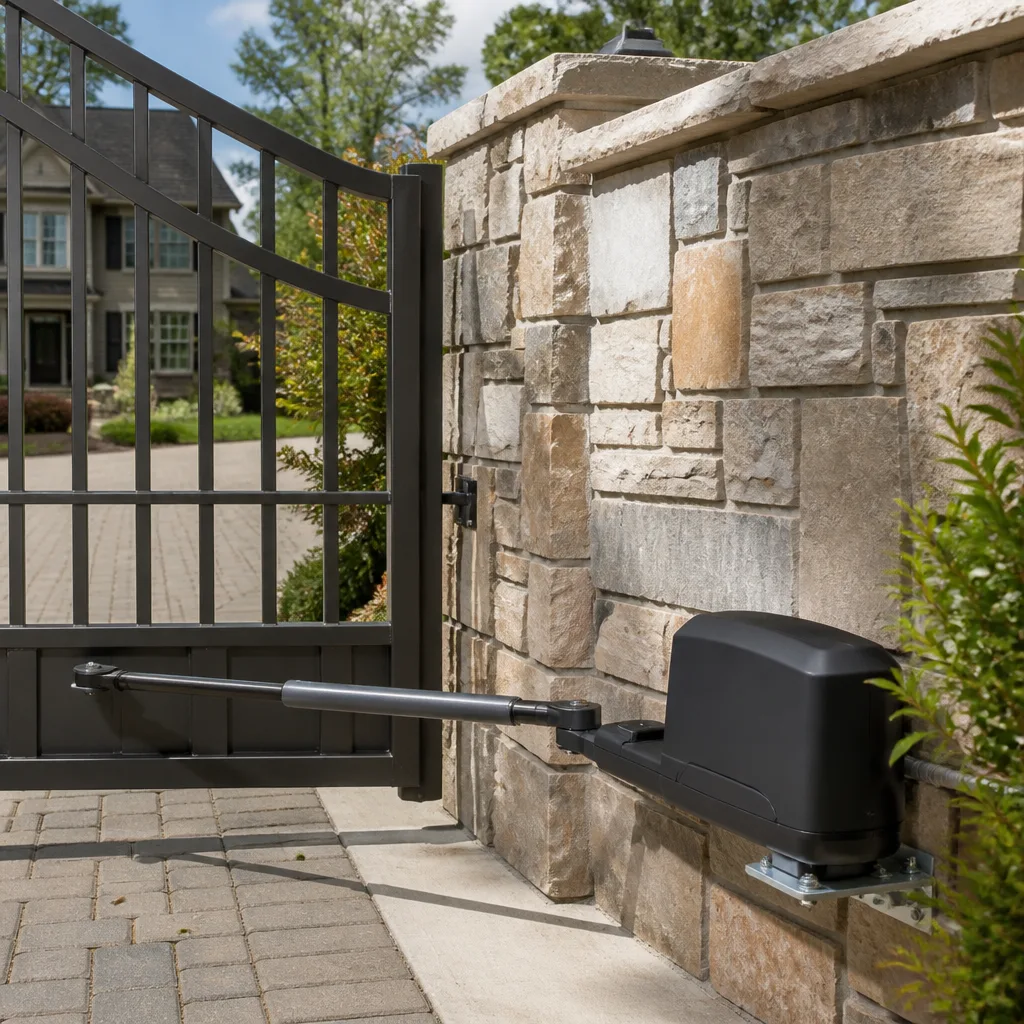
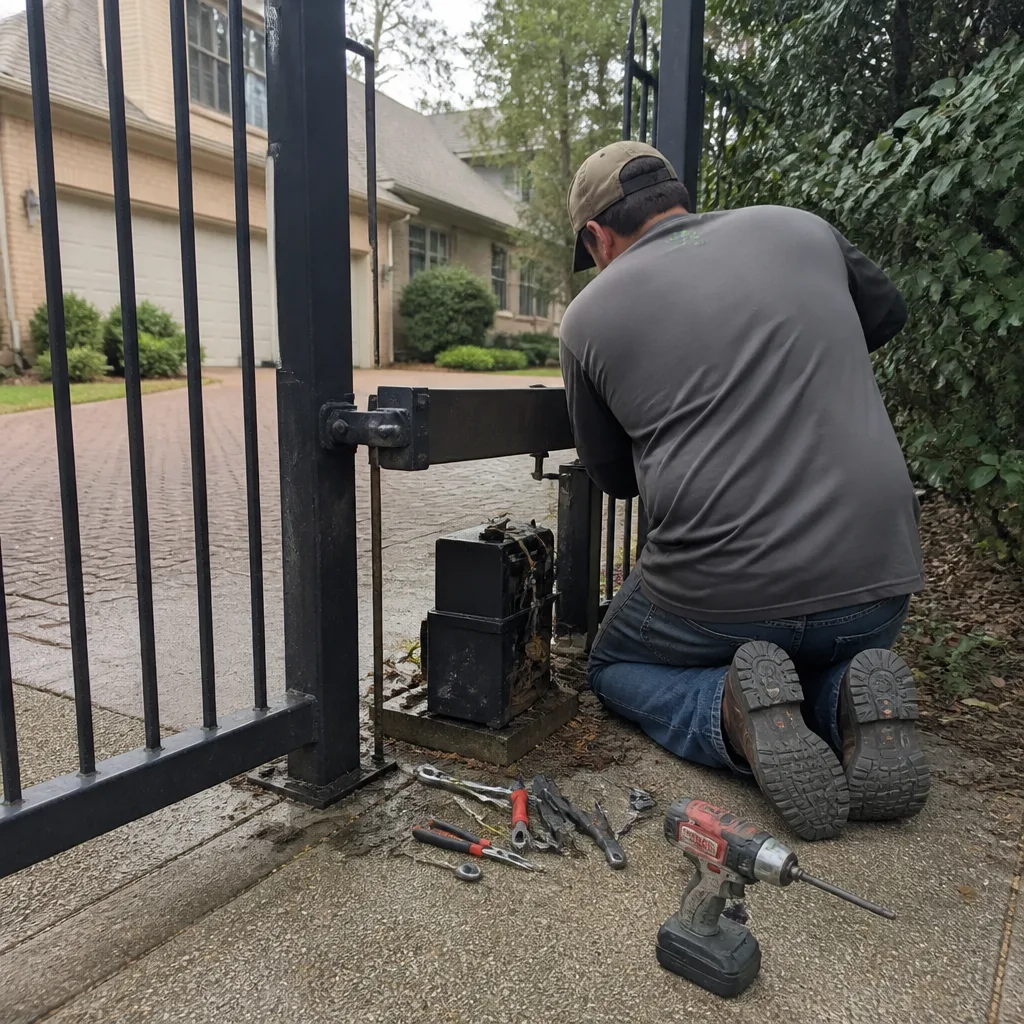 Before
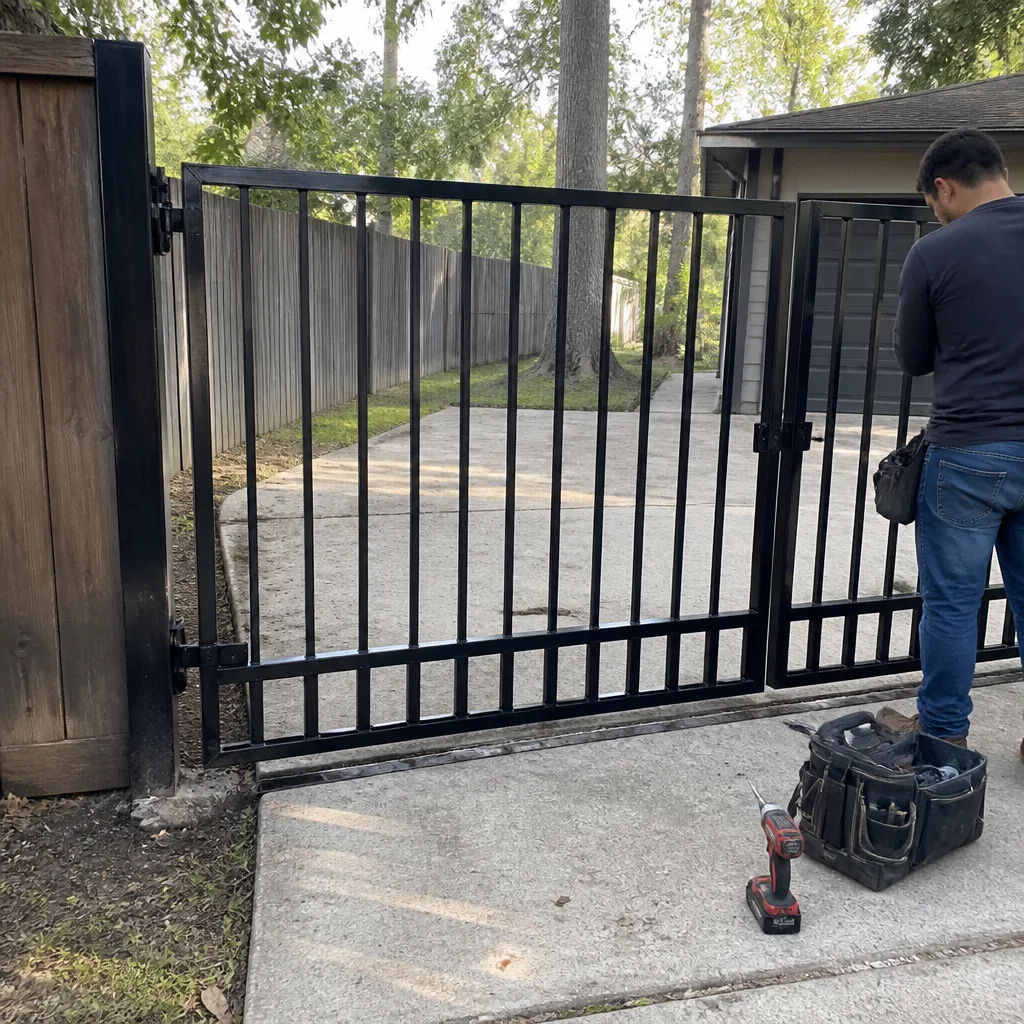 After
After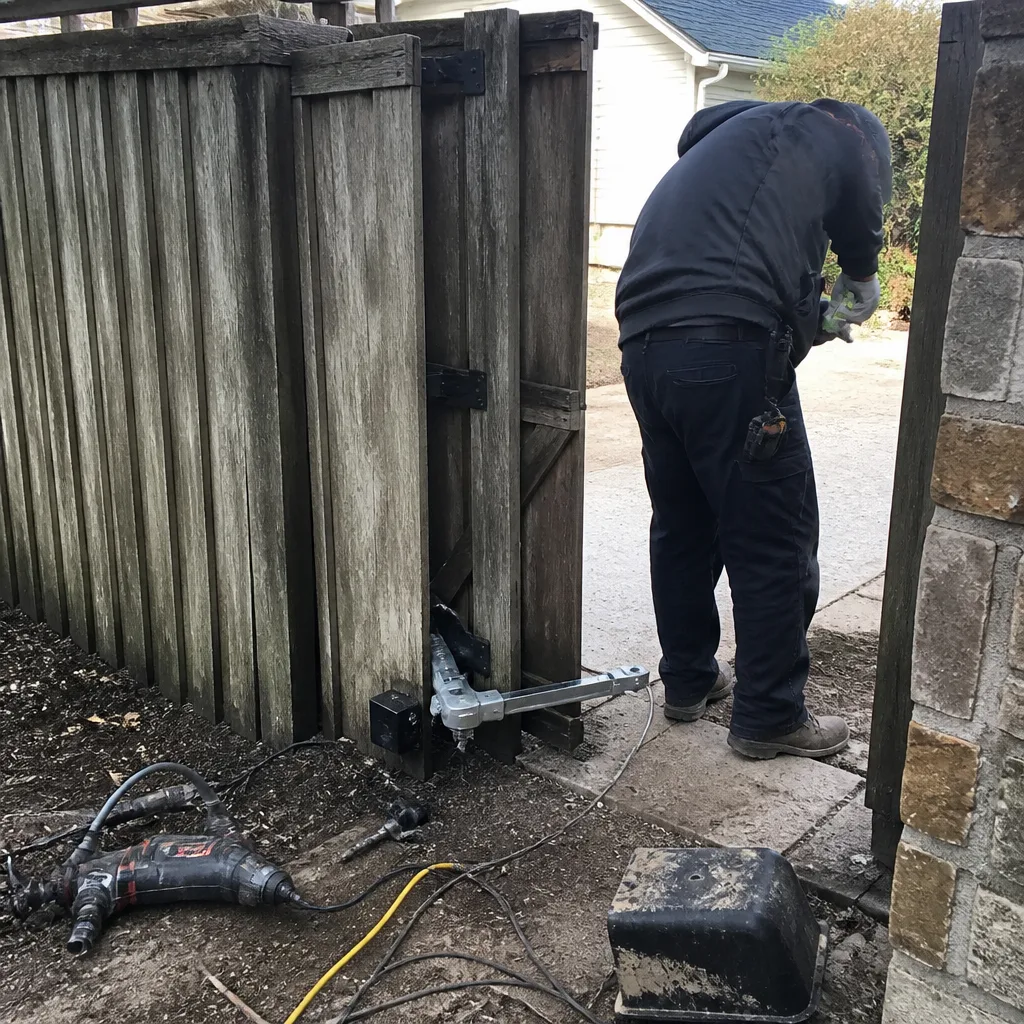 Before
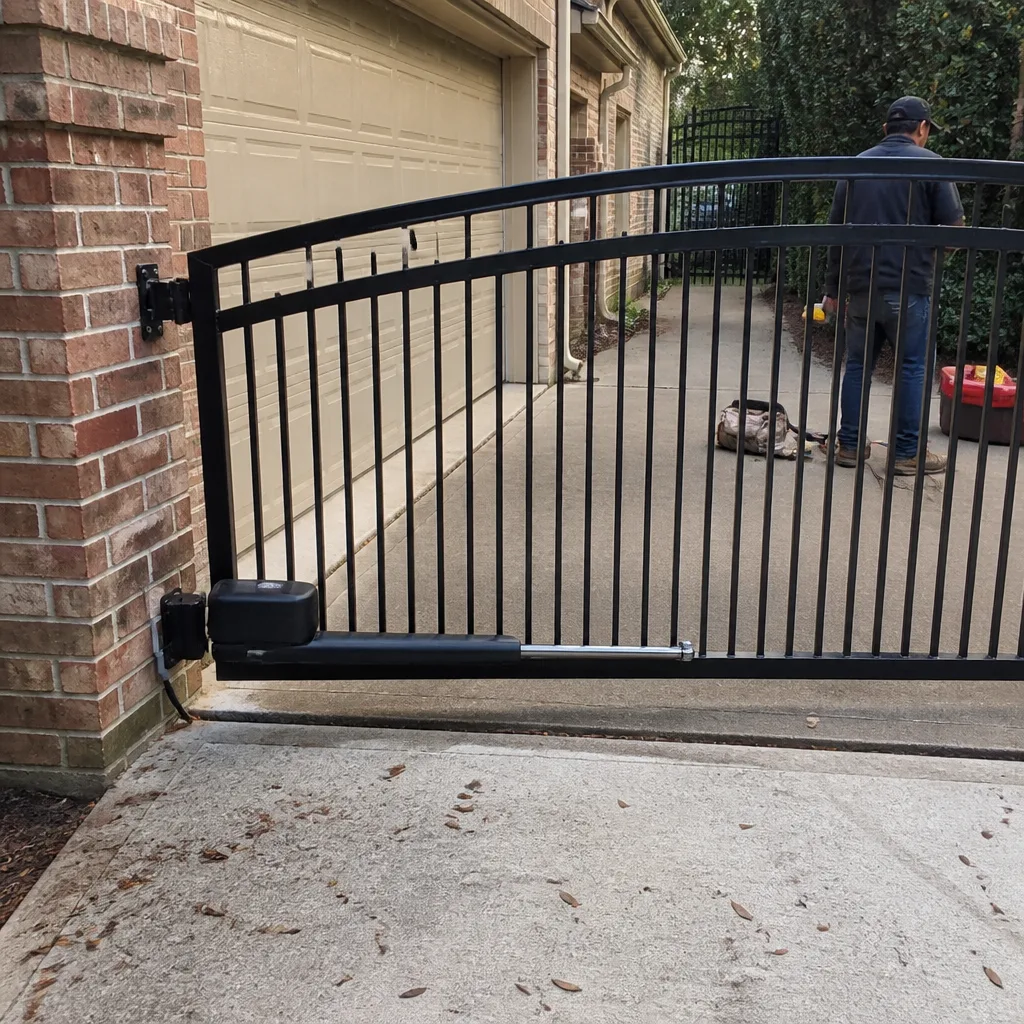 After
After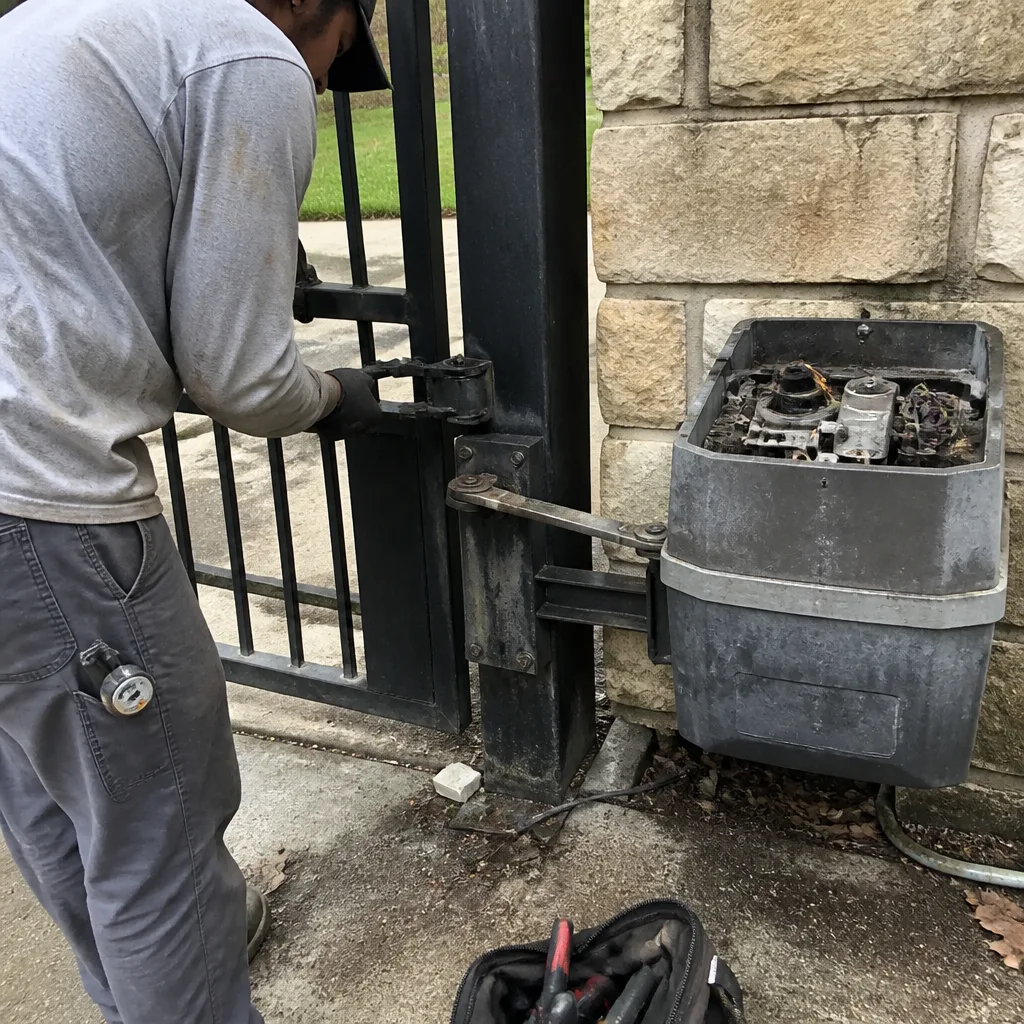 Before
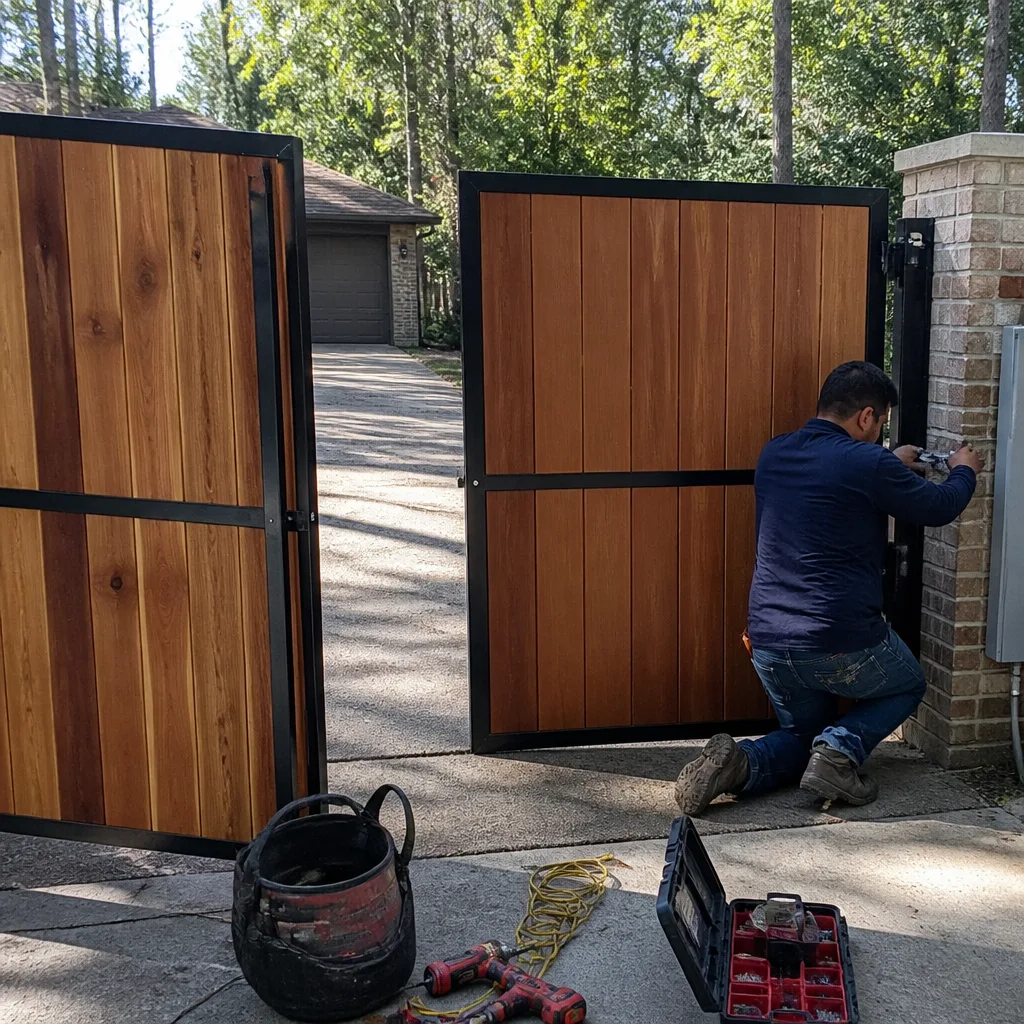 After
AfterThe Complete Guide to Gate Repair in The Woodlands
A gate that stops mid-cycle isn’t “broken,” it’s reporting a specific fault with its body. The limit switch that fails to trip, the hinge that binds after a rain, the photo-eye that lost alignment at 2 a.m. - each one leaves physical evidence a careful homeowner can read before ever picking up the phone. In The Woodlands, where clay-heavy soil shifts seasonally and humidity works on every electrical connection, most gate failures trace to one of four documented root causes. This guide maps each failure to its evidence, walks through the diagnostics worth doing from the driveway, and explains what a complete repair record should look like when the technician leaves. By the end, you’ll know whether you’re facing a $180 adjustment or an $1,800 operator replacement, and why the difference shows up in a limit-switch reading, not in a sales pitch.
Quick Answer
Gate repair in The Woodlands typically costs between $180 and $1,800 depending on which of four failure categories you’re dealing with: electrical, mechanical, structural, or access-control. For a detailed breakdown of what drives these price differences, see our Gate Repair Cost Breakdown: The The Woodlands Homeowner’s Reference for 2026. The single most valuable diagnostic step a homeowner can take is the manual-release test - disengage the operator and swing the gate by hand. If it moves smoothly, you have an operator or electrical fault, not a structural one, and that distinction alone determines whether the repair costs hundreds or thousands.
Table of Contents
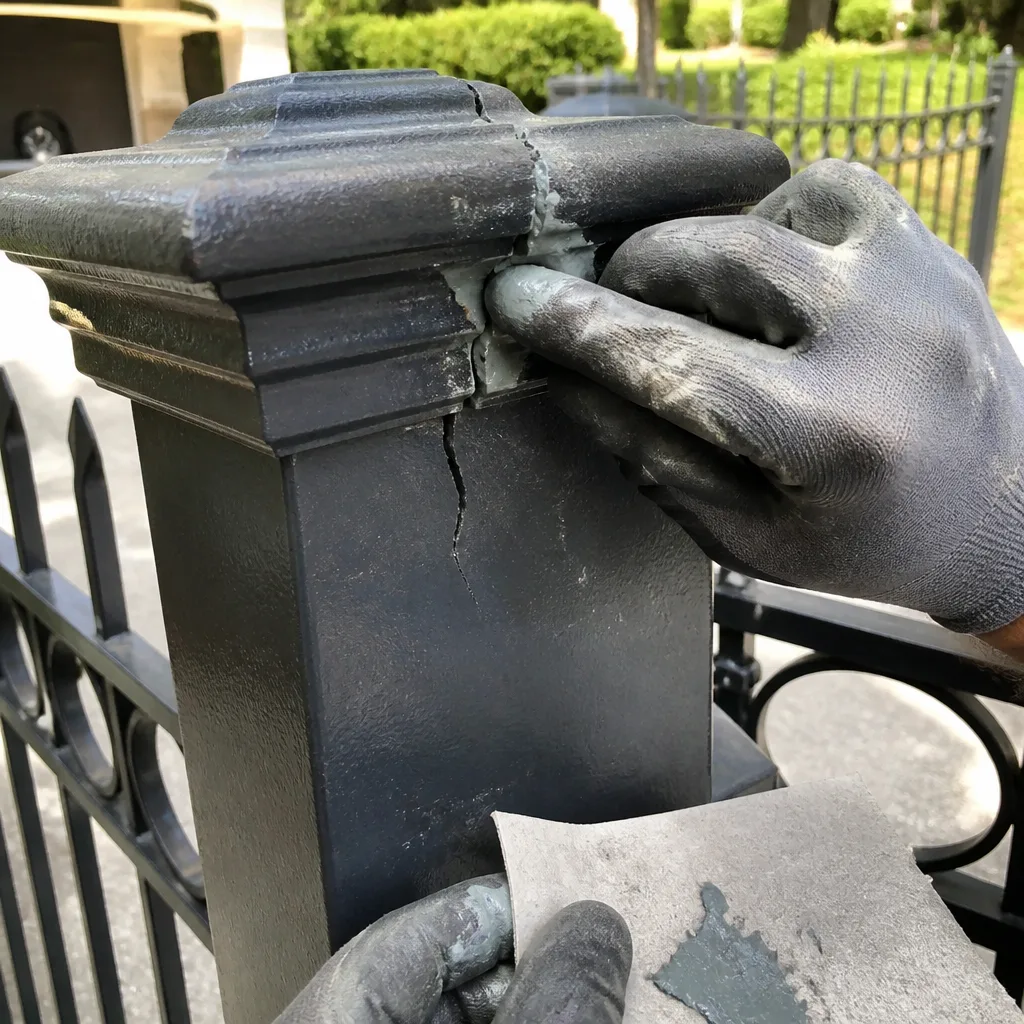
- The Four Failure Categories: Physical Evidence That Confirms Each
- The Manual-Release Test: Your First Diagnostic Step
- Clay Soil and Hinge-Post Lean: When Structure Masquerades as Motor Failure
- Operator Faults vs. Structural Faults: How to Tell Them Apart Before Calling
- What a Complete Repair Record Should Contain
- Deed Restrictions and HOA Gate Specs in The Woodlands
- What Gate Repair Costs in The Woodlands
BeforeAfterThe Four Failure Categories: Physical Evidence That Confirms Each
Every gate failure we’ve documented since 2014 falls into one of four categories. The categories matter because they determine the repair scope, the parts, the labor profile, and the price range. More importantly, each category leaves distinct physical evidence. If you know what to look for, you can categorize the failure before the technician arrives, which means you can evaluate the estimate against a diagnosis instead of against a short walk-around.
1. Electrical Failures
Electrical failures live in the low-voltage path: the control board, the limit switches, the photo-eye (the infrared beam that stops the gate if something crosses the path), the receiver on the access-control side, and every splice in between. In The Woodlands, humidity accelerates corrosion at terminal blocks and wire nuts, especially on gates that face north and never get direct sun to burn off morning condensation.
Physical evidence: A gate that operates intermittently, works in dry weather but fails after rain, hums without moving, or trips the breaker repeatedly. The photo-eye may show a misaligned LED or a dirty lens. Limit switches may click but fail to register at the board.
2. Mechanical Failures
Mechanical failures involve the moving parts of the gate itself: rollers, roller trucks, hinges, the rack or chain on slide gates, the actuator arm on swing gates, and the bearings inside the operator’s gearbox. These parts wear, and in The Woodlands the wear profile is often accelerated by grit and fine clay dust that works into bearing surfaces after grading or construction.
Physical evidence: Grinding, squealing, or thumping sounds that correlate with gate movement, not with the motor humming. Visible metal shavings under a roller assembly. A gate that moves smoothly for the first few feet and then binds. Hinges that appear to have dropped a fraction of an inch on one side.
3. Structural Failures
Structural failures are what happens when the post, the gate frame, or the supporting hardware takes the abuse instead of the electrics. In The Woodlands, the primary structural issue is hinge-post lean caused by clay-heavy soil that expands when wet and contracts when dry, gradually moving posts out of plumb. A post can tilt as little as two degrees before the gate geometry stops working cleanly.
Physical evidence: A gate that scrapes the ground or the latch side at one corner, a visible gap that widens at the top or bottom of the gate’s swing arc, stress cracks in the concrete collar around a post, or a gate that no longer meets the latch when it closes.
4. Access-Control Failures
Access-control failures live in the command layer: the keypads, the intercom, the telephone-entry unit, the loop detectors buried under the driveway, and the remote controls. These parts can fail while the physical gate and the operator remain in perfect health. In gated communities across The Woodlands, a dead loop detector is one of the most common reasons a gate won’t open for a vehicle, even though it opens fine for a pedestrian keypad.
Physical evidence: The gate opens with one input but not another - a remote works but the keypad doesn’t, or vice versa. The intercom rings but won’t release the gate. The gate opens after a car arrives but not after a motorcycle, a classic sign of a loop detector with insufficient sensitivity.
Each of the nine major automation brands we service - LiftMaster, FAAC, BFT, Linear, Viking, Ghost Controls, DoorKing, Elite, and Mighty Mule - can produce any of these four failure types. Brand identity matters less than failure category. The category tells you what kind of repair you’re paying for.
The Manual-Release Test: Your First Diagnostic Step
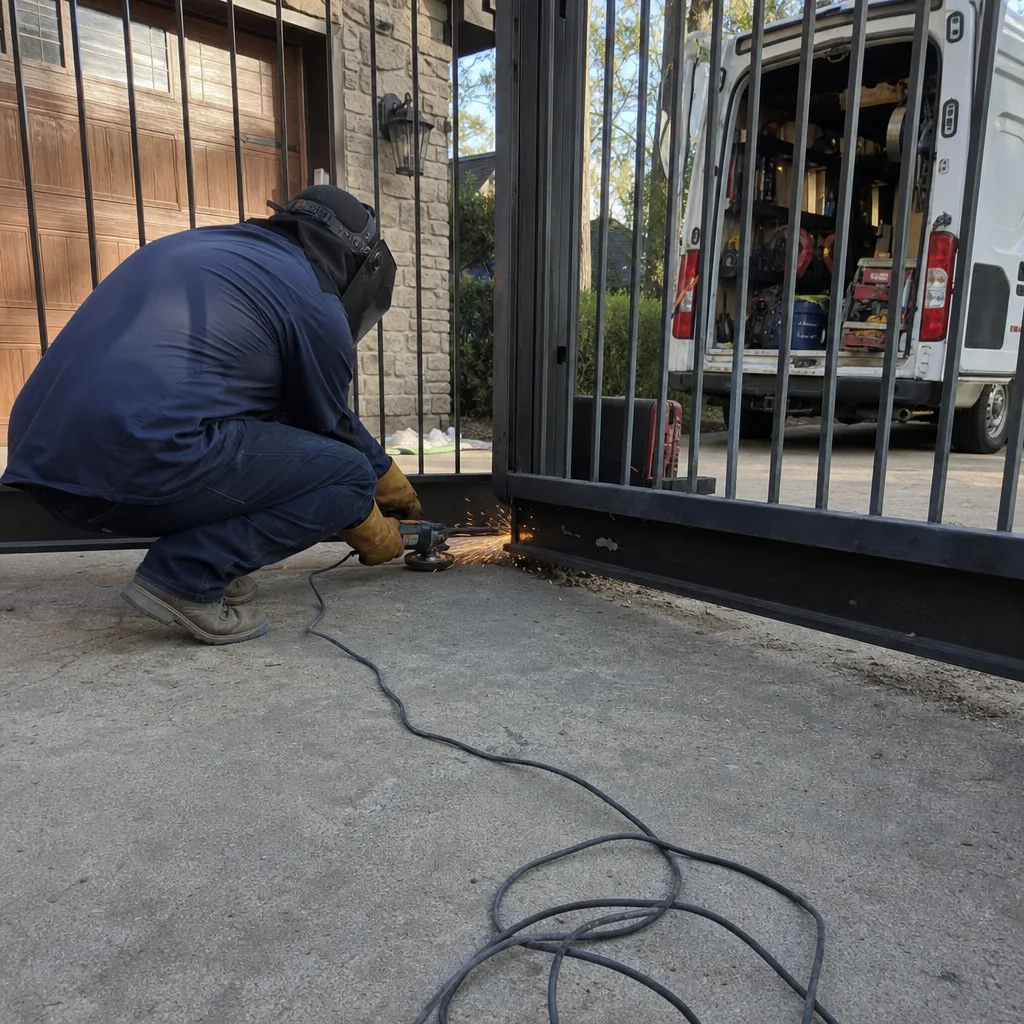
Before anyone picks up a phone, the single most useful diagnostic on a gated property is the manual-release test. Every automated gate operator includes a release mechanism that disengages the motor from the gate so the gate can be moved by hand in a power outage. On a swing gate, it’s usually a handle or keyed release on the operator arm. On a slide gate, it’s typically a lever or a chain-release mechanism on the drive unit.
Here’s the test, step by step:
- Turn off the operator’s power at the breaker or the dedicated disconnect. Never run the manual-release test with power live - you don’t want the operator re-engaging on your hands.
- Disengage the release according to the manufacturer’s lever or key position. If you’re unsure where it is, the operator housing is usually labeled.
- Push or pull the gate through its full travel by hand, both directions. Watch for binding, scraping, or uneven resistance.
- Note the effort required. A healthy gate should move with one hand and maintain its momentum. If it takes two hands, if it stops dead at a specific point, or if it grinds against its track, you’ve just confirmed a mechanical or structural fault.
- Re-engage the release and restore power, then run the gate through one cycle before leaving it.
What the result tells you:
- The gate moves smoothly by hand: The structure and mechanics are fine. The fault is electrical or access-control. The repair path is an operator adjustment or board replacement, not a post excavation.
- The gate binds, scrapes, or requires real effort: The fault is mechanical or structural. No amount of operator adjustment will fix a hinge that’s pulling away or a roller that’s seized.
- The gate won’t move at all: Something physical has failed - a roller snapped out of its truck, a rack is jammed, or the gate has come off its slide path entirely. Stop and call someone before attempting to force it.
This test takes five minutes and saves the most expensive misdiagnosis in gate repair: paying for a motor replacement when the real issue is a post that shifted out of plumb. In The Woodlands, where the clay soil makes post lean a recurring issue, the manual-release test is the most important habit a homeowner can develop.
Clay Soil and Hinge-Post Lean: When Structure Masquerades as Motor Failure
In our experience across The Woodlands, the most expensive misdiagnosis we see is a structural problem treated as an electrical one. The typical presentation: a swing gate that intermittently fails to close, trips the operator’s obstruction sensor, or grinds before the motor stalls. The typical technician response: replace the operator board, adjust the limits, maybe install a new arm. The gate works for a few weeks. Then the same fault returns. The technician who documented the job now has a photo log showing the limits were set correctly. The problem was never the limits.
What’s actually happening, in many of these cases, is that the hinge post has begun to lean. The Woodlands sits on heavy clay that expands significantly when wet and contracts when dry. A post set without sufficient depth or without an adequate concrete collar will move a fraction of a degree with each wet-dry cycle. After enough cycles, the lean becomes material. The gate’s swing arc changes. The latch no longer aligns. The operator, sensing the increased torque or the off-arc obstruction, stops mid-cycle.
How to measure it with a phone:
- Open the compass or level app on your phone and set it to the angle or level reading.
- Place the phone flush against the hinge post, vertical edge, on the side that faces the gate.
- Record the reading. If the post is plumb, the reading will be zero (or within a degree). If the reading shows two degrees or more of tilt toward or away from the gate’s swing arc, you’ve found the culprit.
- Do the same on the latch post. A gate can bind on the latch side, not just the hinge.
- Take a photo of both readings. That photo is evidence you hand to a technician if you call one, and it saves the technician the cost of rediscovering the problem.
A post that leans even two degrees changes the torque required to move the gate, adds load to the operator, and eventually destroys the operator’s gearbox if the condition persists. The gate isn’t reporting a motor fault; it’s reporting a geometry problem, with its body, every time it grinds or stalls.
Operator Faults vs. Structural Faults: How to Tell Them Apart Before Calling
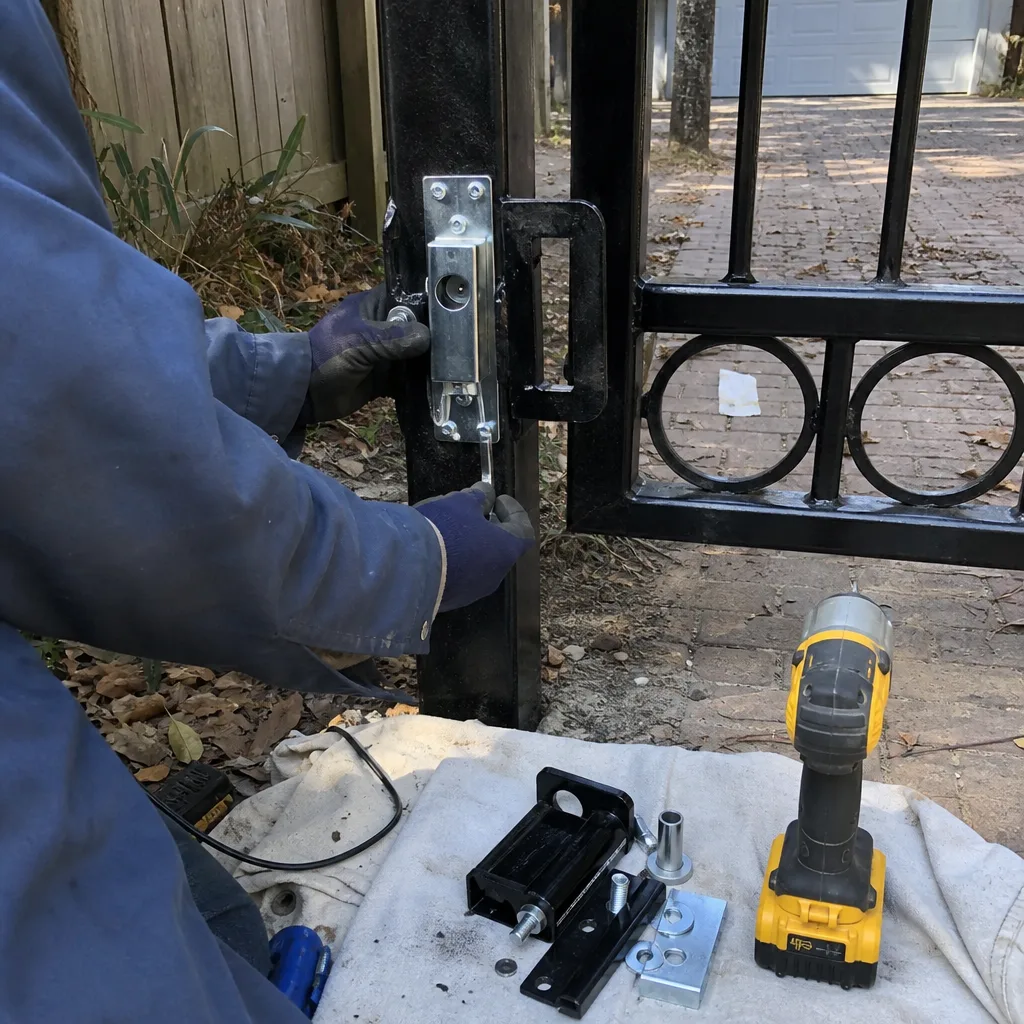
If the manual-release test confirms the gate binds or scrapes, the next question is whether the problem is in the operator assembly (mechanical) or the gate geometry (structural). These two routes lead to very different repair scopes and price tags. A mechanical repair on the operator arm might run $250. A structural repair involving excavation and post reset can run into four figures.
Here’s how to separate them:
Operator-side mechanical faults show up at the joint between the arm and the gate, or inside the gearbox housing itself. The gate moves freely through most of its arc, then hesitates or chatters at one specific point. The operator hums but the arm doesn’t move, indicating a sheared gear, a broken coupling, or a stripped drive. The physical evidence is often visible: a worn pivot bushing, a bent arm bracket, a leaking seal at the gearbox, metal shavings around the operator base.
Structural faults show up at the hinges, the posts, or the gate frame. The gate doesn’t hesitate at one point; it fights through the entire arc. The hinge side drops visibly. The gate scrapes at the latch corner on both the open and close stroke. The post has a visible crack in the concrete collar or gaps around the post base after a dry week.
A useful field distinction: if the problem is reproducible by hand at the same angle every time, and the effort is consistent across the arc, look at the structure. If the problem is intermittent, electrical, or only shows under motor power, look at the operator. The hand test gives you the answer because it removes the motor from the equation entirely.
In The Woodlands neighborhoods like Creekside Park and Sterling Ridge, where lot drainage and soil moisture vary block to block, we see structural failures cluster in specific sections of the same subdivision. One block with deeper clay will produce three hinge-post leans in a year while the next block over produces none. The soil history of a property is as relevant to the gate repair as the model number on the operator.
What a Complete Repair Record Should Contain
Here’s the standard we hold ourselves to, and the standard we’d suggest you hold any gate company to: if the technician leaves without a written record of what was found and what was set, you’ve paid for a service you can’t verify. Every gate repair should produce documentation. Not a verbal summary. Not a line on an invoice that says “adjust gate.” A repair record with enough detail that a future technician can work from it without re-diagnosing everything.
What that record contains:
- Limit-switch readings. Where the limits were set before and after the repair, in degrees or in the control-board’s units. A limit switch that was set 12 degrees past travel is the kind of finding that matters when the same symptom returns two years later.
- Torque-arm photo. A photo of the operator arm at full extension and full retraction, showing the bracket position and any visible wear at the pivot points.
- Wiring diagram or annotated photo. If any wiring was changed, a photo of the new connections with labels. When a board is replaced, the wire order should be documented.
- Part numbers installed. Not “new sensor” but the actual manufacturer’s part number. A photo-eye from one brand is not interchangeable with a photo-eye from another, and the part number is the only thing that matters when sourcing a replacement.
- Photo log of the failure as found. Before photos, not just after photos. The cracked roller, the corroded terminal, the misaligned photo-eye - captured as evidence, before the repair changes the scene.
Why this matters: a gate repair that isn’t documented is a repair that costs money twice. The next technician has to figure out what the last one did. Motors get swapped when a $15 part was the problem. Limits get reset into a bad position because no one recorded where they were. Board settings get lost when the power cycles and no one photographed the dip-switch positions.
Adrian Vance started his career on commercial access-control sites, where every wiring change goes into a job folder because the next contractor on site will not guess. That documentation habit carried over into residential gate work, and it’s why every job here includes a recorded photo log and a written record of the part installed. Under the Haven Standard’s Clause 4 (Evidence on every job), the photo record and the written scope are deliverables, not a courtesy.
Deed Restrictions and HOA Gate Specs in The Woodlands
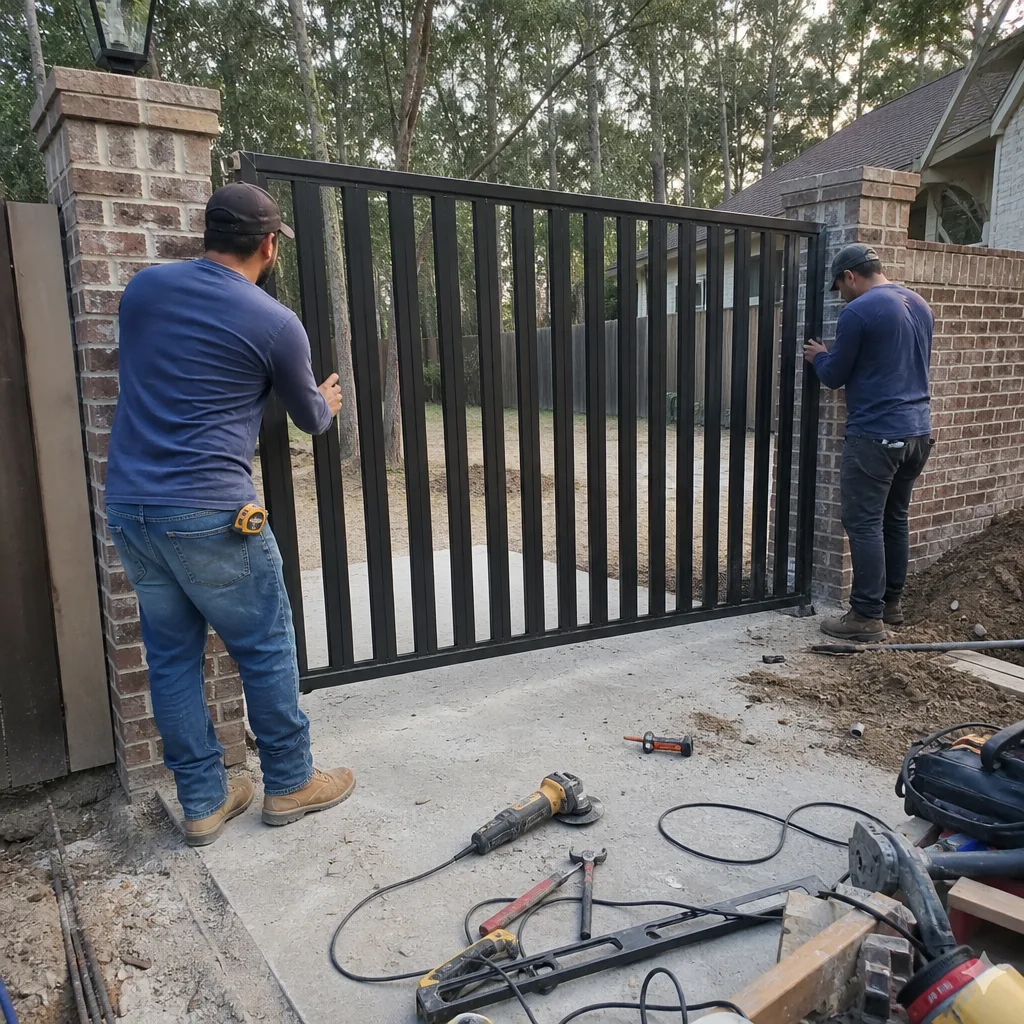
Most residential gate repairs in The Woodlands don’t require a permit, but they can require something more time-consuming than a permit: a deed-restriction review. Villages like Creekside Park and Sterling Ridge operate under architectural guidelines that extend to gates and fences, including height, material, color, and the direction a gate swings. If a repair changes the appearance of the gate - a new operator arm, a different slide track, a change in hardware profile - the HOA or village association may need to be consulted before the work starts.
What this means practically:
- Replacing like-for-like parts rarely triggers review. A new control board for a LiftMaster operator, a replacement photo-eye, a set of rollers - these are repair items, and most associations in The Woodlands treat them as routine maintenance.
- Changing the operator type can trigger review. If a swing gate operator comes off and a slide conversion is proposed, the association will typically want to see the scope before approval.
- Material changes always require review. Replacing a wooden picket section with steel, changing a gate’s height, or adding a solid infill panel for privacy changes the visual profile and the gate’s weight. Both of those change how the gate operates, and both would need sign-off.
- Gate swing direction is often fixed by the plat. Some lots in The Woodlands have a recorded swing direction for the driveway gate. Changing it may require a variance, which is a longer process than the repair itself.
If you’re not sure whether your association has spec requirements, the gate company you choose should be able to review your deed restrictions and flag anything that affects the repair scope. In a worst-case scenario, a repair that doesn’t match the governing docs can trigger a notice to cure, which turns a one-day job into a multi-week compliance cycle.
Our team handles the review as part of the written scope. If the gate work needs association review, it’s noted in the document you sign before the work starts, with the exact section of the governing docs cited. No surprise notices to cure.
What Gate Repair Costs in The Woodlands
Gate repair in The Woodlands is priced by failure category and by parts, not by the hour. That’s a meaningful distinction: the market here has a mix of flat-rate and hourly pricing, and the difference shows up in the final invoice. A flat-rate repair written before work starts protects you from the hours stacking up while a technician chases an intermittent fault. Here’s what we see in the local market:
| Repair Type | Typical Range | What’s Included |
|---|---|---|
| Limit-switch adjustment or photo-eye realignment | $180-$300 | On-site adjustment, verification cycle, photo log of new settings |
| Operator arm replacement (swing gate) | $450-$900 | New arm, bracket check, torque adjustments, documentation |
| Control board replacement | $350-$750 | Board, wiring verification, dip-switch setup, photo record |
| Full operator replacement (motor unit) | $1,100-$1,900 | New operator, mounting, limit setup, test cycles, documentation |
| Hinge replacement (pair) | $250-$600 | New hinges, gate removal and rehang, alignment verification |
| Hinge-post reset (excavation and re-anchor) | $900-$2,500 | Post extraction or reinforcement, concrete work, gate re-hang |
| Loop detector replacement | $400-$900 | New loop or detector card, driveway saw cut, seal restoration |
The swing-gate motor replacement range cited above depends heavily on brand and condition. A basic Mighty Mule or Ghost Controls replacement on an intact bracket will land on the low end. A LiftMaster or FAAC operator on a heavy custom gate with a worn arm bracket can push toward the high end. The bracket condition matters as much as the brand: if the arm attachment has been bent by torque, the new motor will be fighting the same mechanical load from day one.
Every price we write is flat and written before work starts. No hourly billing, no surcharges discovered later. If the scope changes mid-repair, the new price is written and agreed before the additional work starts. That’s Haven Standard Clause 1 (Have it in writing), and it applies to every job on every gate.
For an exact quote on your gate, call our gate repair page for more detail or dial (346) 296-3138.
Common Mistakes to Avoid
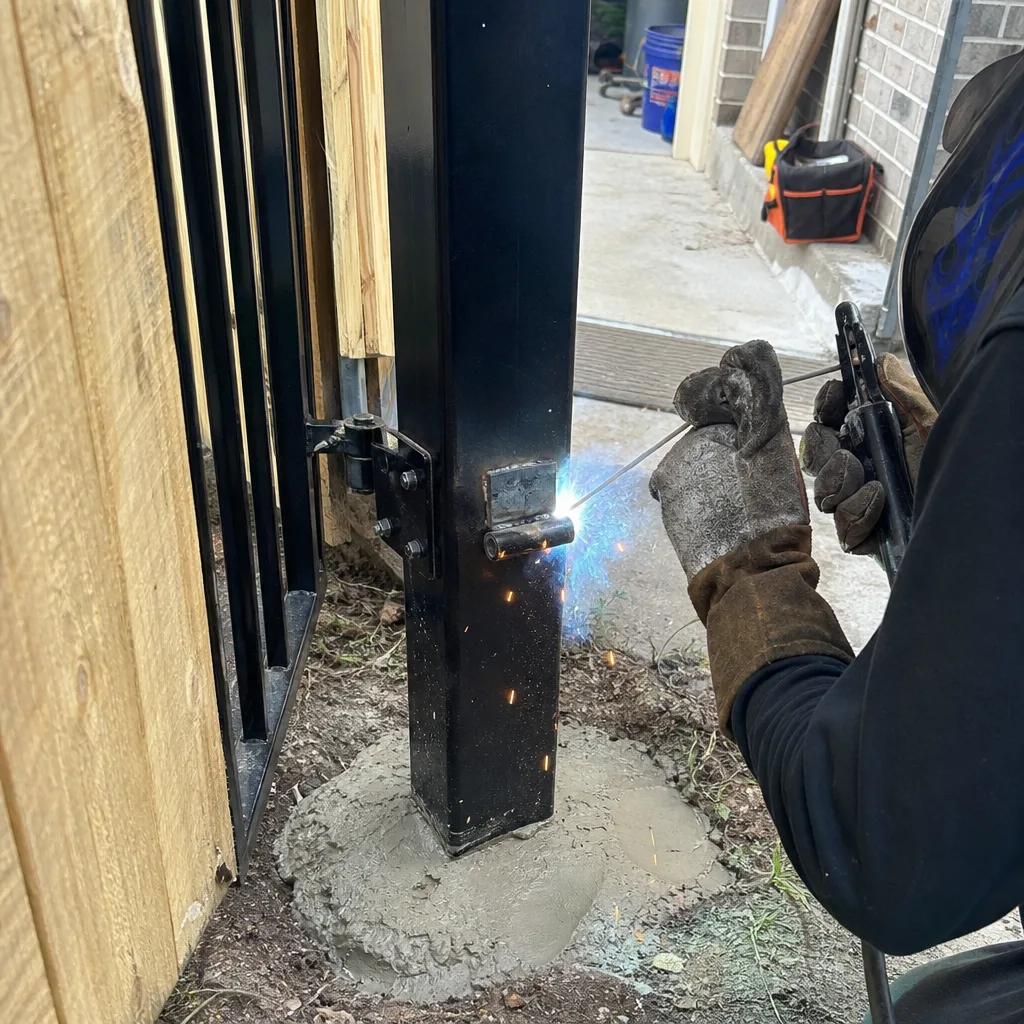
- Replacing the operator before testing the gate by hand. If the gate binds, the new operator will fail the same way the old one did, just on a later calendar date. The manual-release test costs five minutes and saves the most expensive mistake in this trade.
- Adjusting limits to “fix” a structural problem. Cranking the limit settings to force a leaning gate through its travel buys weeks, not months, and adds load to the gearbox that fails expensively. The gate is telling you the geometry is off, not that the travel is set wrong.
- Ignoring the photo-eye. A misaligned photo-eye is the most common cause of a gate that reverses for no apparent reason in The Woodlands. Heat, wind, and the vibration of daily cycles are enough to knock a beam out of alignment by two inches.
- Paying hourly rates for an intermittent fault. Intermittent faults are difficult to reproduce. A technician on a time-and-materials ticket has little incentive to close the diagnosis quickly. A flat-rate scope you’ve agreed to before work starts keeps the incentive where it belongs: on fixing the gate.
- Skipping the documentation. If the technician can’t produce a written record of what was found and set, you can’t verify the repair and the next visit starts from zero. You’ll pay twice to rediscover the same problem.
- Waiting until the gate is fully down to call. A gate that’s binding is wearing every part in its chain. The longer it runs compromised, the more parts fail. The $300 hinge job becomes a $1,800 operator replacement because the motor burned out fighting the resistance.
When to Call a Professional
Call a professional when the manual-release test confirms binding you can’t see, when the gate trips a breaker or blows a fuse repeatedly, when the operator hums without moving the gate, or when any repair involves the operator’s internal gears, the gate’s structural posts, or the buried loop detector under the driveway. The gearbox spring inside a gate operator is under significant tension and should never be opened by someone who hasn’t been trained in the torque specs. The same applies to any repair that requires cutting into concrete to replace a loop detector. Vance Gate Repair The Woodlands offers Gate Repair services with free estimates in The Woodlands - call (346) 296-3138, and you’ll get a written price before any work begins.
Frequently Asked Questions
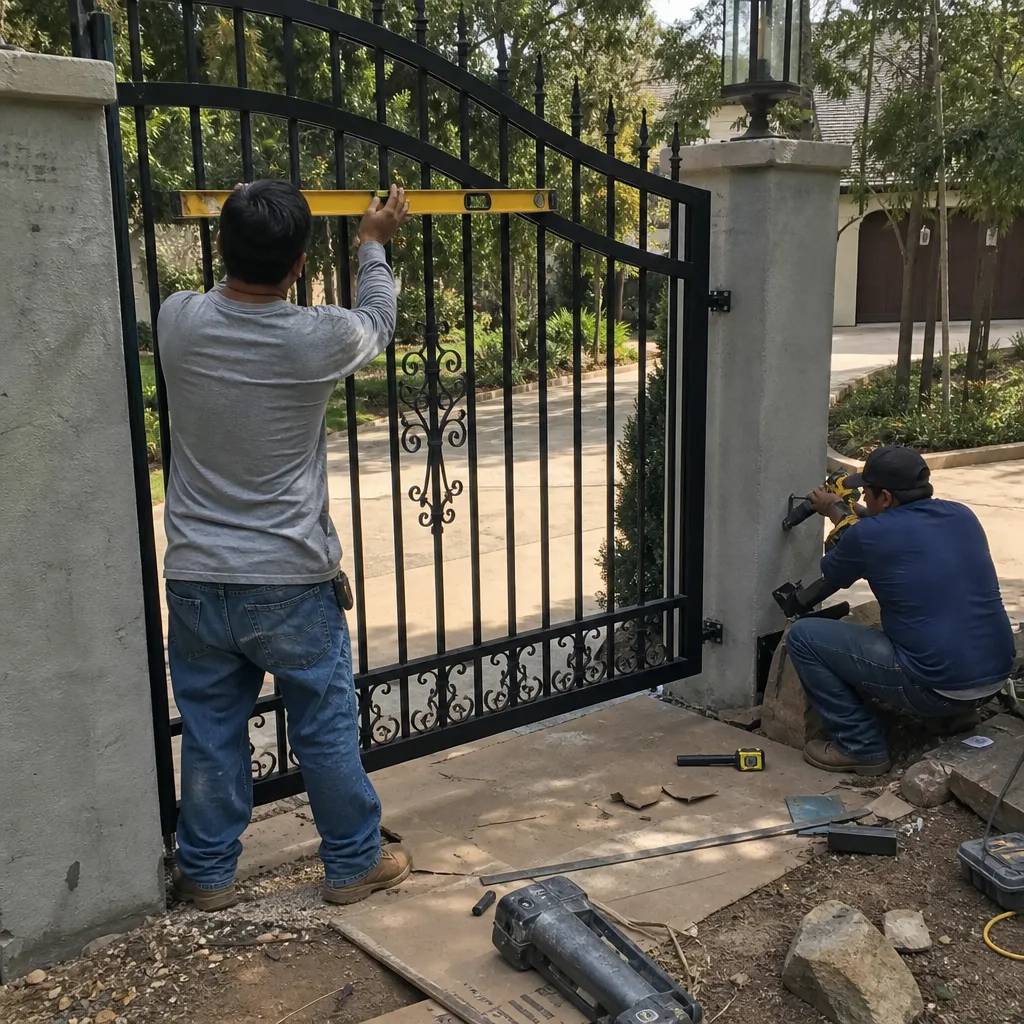
Gate repair in The Woodlands typically ranges from $180 to $1,900 depending on the failure category. A limit-switch adjustment or photo-eye realignment runs $180 to $300, while a full operator replacement runs $1,100 to $1,900. The exact price depends on the brand (LiftMaster, FAAC, BFT, and Mighty Mule are common here), the gate’s weight, and whether the arm bracket or other structural components have worn. Call (346) 296-3138 for a written quote on your specific gate.
A gate that stops halfway and reverses is usually reporting an obstruction signal from the photo-eye or an over-torque condition at the operator. The photo-eye can be misaligned by as little as two inches - enough to trigger the safety reverse every time the gate’s motion or a passing car’s vibration shifts the beam. Less commonly, the operator’s torque sensor is detecting an overload from a binding hinge or a post that has leaned. Run the manual-release test to rule out structure, then inspect the photo-eye alignment.
For many electrical and mechanical repairs, yes. Adjustments, photo-eye realignment, control board swaps, and most operator arm replacements are same-day jobs. Structural repairs like hinge-post resets require excavation and concrete work, which is scheduled, not dispatched. If the issue is urgent, describe the failure category you’re seeing (electrical, mechanical, structural, or access-control) when you call (346) 296-3138, and we can tell you what’s realistic for same-day service.
Like-for-like part replacements typically don’t require association review. Changing the operator type, the gate’s material, its height, or its swing direction may require sign-off from your village association, particularly in communities like Creekside Park and Sterling Ridge. The written scope from any repair should flag any association review required, with the governing section cited, before the work starts.
The manual-release test disengages the gate operator so the gate can be moved by hand. If the gate moves smoothly, the fault is electrical or in the operator. If it binds or scrapes, the fault is mechanical or structural. This one test eliminates the most expensive misdiagnosis in gate repair: replacing a motor when the real problem is a shifted post. It takes five minutes and every homeowner with an automated gate should know how to run it.
Expect seven to twelve years from a quality operator in The Woodlands, with the swing side on the shorter end if the operator faces direct afternoon sun and the control board is sealed against humidity. Operators on gates that bind, or on posts that have shifted, die earlier - sometimes much earlier. The most common cause of premature operator death we document is not age; it’s running the motor against a structural or mechanical fault for months before addressing the root cause.
The Bottom Line
Gate repair in The Woodlands is a diagnostic discipline before it’s a parts purchase. The four failure categories - electrical, mechanical, structural, and access-control - each leave physical evidence you can read. The manual-release test separates operator faults from structural ones in five minutes. The clay soil here makes post lean the most common silent killer of otherwise healthy operators. A documented repair record is the difference between paying once and paying twice. And a written price before work starts is the difference between a repair you control and a bill that controls you. Vance Gate Repair The Woodlands has repaired over 22,000 gates since 2014, every one with a written scope and a photo record. Call (346) 296-3138 for a free estimate.
Written by Adrian Vance, Owner at Vance Gate Repair The Woodlands, serving The Woodlands since 2014. Explore more guides & resources.